



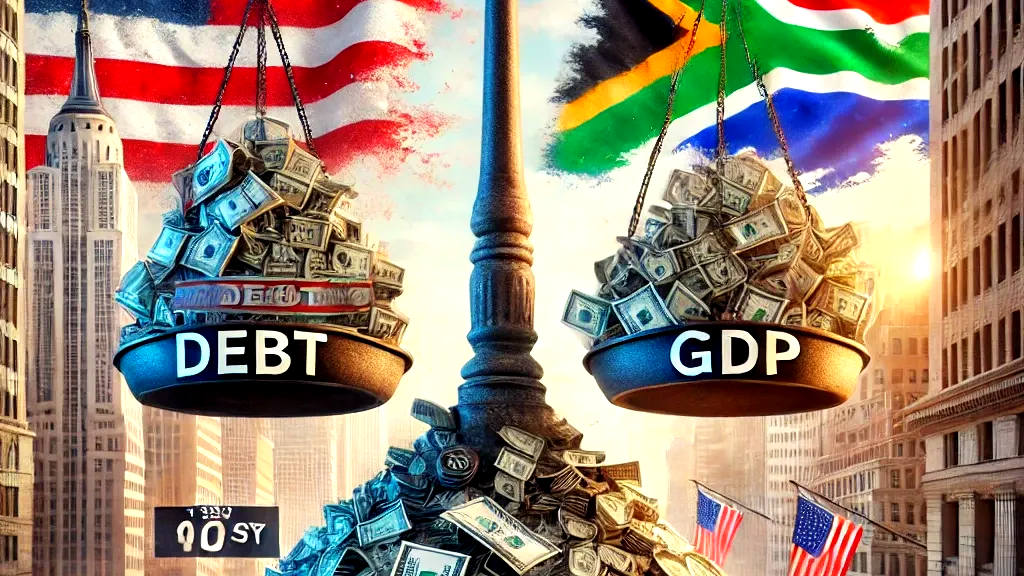
As of February 28, 2025, the United States’ national debt stands at an astonishing $36.22 trillion, with projections indicating that it could surpass 130% of GDP by 2035. Given these figures, it is understandable that the U.S. is prioritizing domestic spending over foreign aid. Yet, South Africa—a 30-year-old democracy with substantial tax revenues—continues to rely on American aid to fund critical programs like HIV medication. This is not a financial crisis; it is a crisis of corruption and mismanagement.
South Africa Does Not Have a Money Problem—It Has a Theft Problem
Between 2023 and 2024, South Africa’s government departments and state-owned entities (SOEs) reported irregular expenditures exceeding R49.5 billion, with an additional R2.57 billion wasted on fruitless spending. Corruption Watch and OUTA estimate that corruption alone costs South Africa between R150 billion and R200 billion annually. These figures dwarf the aid historically provided by the U.S., yet instead of fixing the systemic failures at home, South Africa continues to seek foreign assistance.
Why Should U.S. Taxpayers Fund South Africa’s Healthcare?
The United States has historically supported South Africa’s fight against HIV/AIDS, but with its own fiscal challenges, including a national debt of $36.22 trillion and a debt-to-GDP ratio of 123%, it is no surprise that America is reevaluating its aid priorities. The question South Africans should be asking is: why are we still dependent on foreign nations when we have the financial capacity to support ourselves?
The Hypocrisy of Overspending While Begging for Aid
Despite the country’s financial struggles, the South African government continues to maintain an oversized executive, spending at least R1.2 billion annually on 75 Ministers and Deputy Ministers. This includes:
- R181.33 million in salaries for Ministers and Deputies
- R467.33 million in support staff salaries
- R553 million in additional perks
- 97 luxury residences for Ministers and Deputies worth over R1 billion
With such expenditures, it is unacceptable to claim that South Africa cannot afford to finance its own healthcare programs.
Ramaphosa’s Unrealistic Plans: From Smart Cities to NHI
The National Health Insurance (NHI) plan is yet another example of government overreach without financial pragmatism. Initial estimates in 2019 projected the cost to be approximately R256 billion by 2022. However, more recent figures suggest that by 2026, the transition to NHI will require an additional R33 billion. These numbers are fluid, subject to change as economic conditions shift, yet the government continues pushing unrealistic policies. This reminds us of President Ramaphosa’s grand promises of a ‘smart city’—an idea that has yet to materialize. When will he start being realistic?
The Catastrophic Loss of AGOA and U.S. Trade Relations
South Africa’s reliance on trade with the U.S. cannot be overstated. As of 2024, trade between South Africa and the United States reached approximately $20.5 billion, with South Africa exporting $14.7 billion worth of goods to the U.S. and importing $5.8 billion. The African Growth and Opportunity Act (AGOA) has played a crucial role in facilitating this trade, particularly benefiting industries like agriculture, automotive manufacturing, and textiles.
- Agriculture: South Africa’s agricultural exports to the U.S. reached $646 million (R12 billion) in 2022, supporting job creation in citrus, nuts, wine, dairy, and more.
- Automotive Manufacturing: By 2024, South Africa’s vehicle exports to the U.S. under AGOA had reached approximately 80,000 units, contributing significantly to the country’s automotive sector and job creation.
- Textiles and Apparel: Despite challenges, this sector remains critical for low-income workers, accounting for 10.3% of manufacturing employment.
AGOA has directly contributed to the employment of approximately 93,000 South Africans, with total U.S. trade supporting around 426,000 jobs in the country. Losing AGOA would be a severe economic setback.
Comparing U.S. Trade to Russia and Iran
Despite increasing diplomatic ties with Russia and Iran, the economic benefits of these relationships pale in comparison to those with the U.S.
- U.S. Trade (2024): Exports: R157 billion; Imports: R120 billion; Trade Surplus: R36 billion.
- Russia Trade (2024): Exports: R5.4 billion; Imports: R10 billion; Trade Deficit: R4.8 billion.
- Iran Trade (2024): Exports: R359 million; Imports: R68 million; Trade Surplus: R291 million.
The stark contrast in trade volume highlights the economic risks of alienating the U.S. in favor of less beneficial relationships with countries like Russia and Iran.
Strained Relations with the U.S.: South Africa’s Missteps
South Africa’s recent actions have placed further strain on its relationship with the United States. In February 2025, President Donald Trump issued an executive order suspending all U.S. aid to South Africa, citing disapproval of its land expropriation policies and its genocide case against Israel at the International Court of Justice. Additionally, the Trump administration has terminated over 90% of U.S.-funded health projects globally, including significant HIV/AIDS programs in South Africa, aligning with its “America First” agenda.
South Africa’s Financial Reality: Debt, Borrowing, and Priorities
In terms of foreign currency borrowing, South Africa’s gross borrowing requirement was projected to decrease from R553.1 billion in 2023/24 to R428.5 billion in 2026/27. To manage rising debt, the government announced plans in February 2024 to draw down $8 billion over three years from contingency reserves held at the central bank. Meanwhile, as of December 2024, South Africa’s national government debt stood at approximately $300.2 billion USD, representing about 75.1% of the country’s GDP. Debt interest payments for 2024/25 were allocated R388.9 billion—more than what is spent on basic education (R323.3 billion) and healthcare (R274.0 billion). This equates to an astounding R1.06 billion per day spent on servicing debt.
Thanking the U.S., Not Blaming It
Instead of criticizing the U.S. for cutting aid, South Africa should be thanking it for decades of support. The U.S. has been a valuable trade partner and ally, and given its own economic constraints, it is logical for it to prioritize its own citizens. South Africa’s government must accept responsibility instead of playing the victim.
If Ramaphosa wants to play a political popularity game with Trump, he is bound to lose. The world is increasingly losing patience with ‘woke’ guilt-tripping and race-card politics. Sympathy for such tactics is fading fast. South Africa needs to stop relying on outdated narratives and start focusing on real, sustainable economic solutions.
A Call for Self-Sufficiency
South Africa has the resources to fund its own development. The real challenge is not a lack of money but a lack of accountability. If corruption and mismanagement were tackled effectively, South Africa would have ample funds to support vital services without relying on foreign aid. It is time for South Africans to demand better governance, greater transparency, and fiscal responsibility from their leaders.
The era of dependency must end. It is time for South Africa to prove its independence—not just politically, but financially.


Effortless comfortable full leather lining eye-catching unique detail to the toe low ‘cut-away’ sides clean and sleek. Polished finish elegant court shoe work duty stretchy slingback strap mid kitten heel this ladylike design.