





How Hudaco turned inventory, decentralisation, and discipline into a durable edge
Hudaco’s edge was never glamorous. It was built on an unfashionable mastery of stock, structure, and self-control — and it held precisely because those things are hard to copy.
The group sources from more than 800 international suppliers, holds over 230,000 line items, and serves roughly 30,000 active customers through 29 businesses and more than 130 branches. Hudaco doesn’t sell parts. It sells certainty: the right bearing, battery, or diesel-engine spare, immediately available with technical advice, in markets where supplier lead times can stretch from three months to well over a year. That promise turns distribution into a moat — and the ratios show what it costs to keep it. Inventory turnover fell from 2.54x in 2021 to 2.14x in 2025, days outstanding rose from 144 to 170, and the cash conversion cycle lengthened from 140 to 168 days. In most businesses, those numbers would look clumsy; at Hudaco, they are the carrying cost of being the supplier that actually has the part.
The model is deliberately decentralised. Acquired businesses keep their brands, people, and customer relationships. The group supplies capital and discipline; the businesses supply judgement and speed.
That design was tested hard. Load-shedding, port dysfunction, recession, riots, and flooding — Hudaco moved through all of it and still produced R8.748 billion in turnover, R1.097 billion in operating profit, a 12.5% margin, and 9.6% EPS growth in 2025. Between 2021 and 2025, EBITDA grew from R883 million to R1.167 billion, dividends from 760 to 1,120 cents, and net debt to EBITDA fell to 0.84x. Growth, margin improvement, rising dividends, lower leverage — that is what separates a resilient business from a compounding one.
Why a niche distributor kept compounding while South Africa kept breaking down
The companies that survived South Africa’s last decade without permanent damage were the ones that never bet on improvement. Hudaco’s design assumed friction. Inventory wasn’t a cost to minimise; it was the product. Long lead times weren’t an inconvenience; they were the reason customers couldn’t risk buying from anyone else. Every mine or factory that couldn’t afford a week’s delay was a captive market for whoever could promise availability with technical competence behind it.
Decentralisation did what head-office management rarely can: it kept the entrepreneurial edge of acquired businesses alive while applying group-level capital discipline where it counted.
The segment data makes the positioning visible. Consumer-related revenue barely moved — R3.78 billion to R3.80 billion — while engineering consumables grew from R3.50 billion to R4.97 billion. Engineering operating income rose from R366 million to R696 million; consumer-related fell from R552 million to R477 million. EBITDA margin climbed from 12.2% to 13.3%, and free cash flow before working-capital movements rose from roughly R736 million to about R1.0 billion. Hudaco did not merely survive the country’s disorder. It learned to price it.
Inside the model that made “boring” one of the market’s best businesses
The product isn’t the part. It’s the confidence that the part will be there — today, with someone who can tell you whether it’s the right one and help when something goes wrong. Specification advice, training, troubleshooting, and credit are what separate Hudaco from a warehouse with a catalogue. Porter argued that the essence of strategy is choosing what not to do. Hudaco chose not to chase project markets, not to centralise, not to compete on price where it could compete on certainty. That restraint is the strategy.
It works best in maintenance markets, where demand doesn’t collapse when capital investment dries up. A mine that stops because it couldn’t source a bearing doesn’t care what the part cost; it cares that it wasn’t there. Gross margin has averaged 37.0% over five years; the current 37.5% is near the cycle high. EBITDA margin of 13.3% in 2025 is the best in the series. That is a business that understands exactly what it is.
Cash, competence, and capital allocation
The cash-flow record is harder to read than it looks. Reported free cash flow fell from R620 million in 2021 to R537 million in 2023, then surged to R1.256 billion in 2024 before settling at R1.033 billion in 2025. The 2024 spike was flattered by working-capital release; strip that out and underlying free cash flow rose steadily from roughly R736 million to about R1.0 billion. There is also a capex illusion: reported capex runs only R69 million to R105 million a year, but bolt-on acquisitions added R81 million in 2022, R171 million in 2023, R112 million in 2024, and R325 million in 2025. The cash generation is real, but not all of it is freely distributable.
Management has been disciplined: reduce debt, buy back shares when acquisitions aren’t available at the right price, and only acquire when the deal strengthens the portfolio without compromising returns. Net borrowings fell to R508 million in 2025.
At R195 per share, Hudaco trades on roughly 8.25x forward earnings — an earnings yield of about 12.1%. The headline free-cash-flow yield is roughly 24.6%, but that flatters the true run rate: a harder-nosed estimate of sustainable annual free cash flow of around R750 million to R850 million still implies a cash-flow yield of about 13.5% to 15.4% on the current market value, which remains compelling against South Africa’s roughly 8.35% 10-year bond yield and 3.1% CPI. Shareholder yield — dividends, buybacks, and debt reduction combined — was about 14.2% in 2024 and 5.9% in 2025. Street targets ranged from R221.20 to R252.00. You do not need heroic assumptions to get there; you only need the market to price Hudaco like a durable industrial rather than a business waiting to be broken. As Warren Buffett put it, time is the friend of the wonderful company. At 8x earnings, Hudaco is asking investors to do almost nothing except wait.
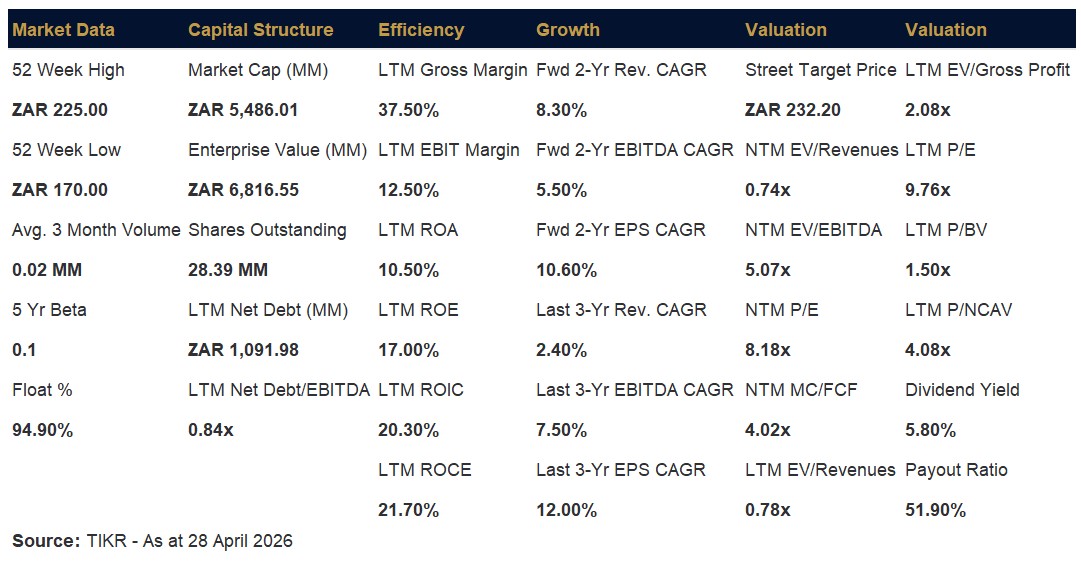
A business earning 17% on equity, 20% on capital, with net debt below 1x EBITDA, trading at 8.25x forward earnings, is not being priced as a quality compounder. A South Africa-adjusted fair multiple of 9.5x to 10.0x on NTM EPS of roughly R23.63 implies fair value of about R225 to R236, against a market price of R195 — an undervaluation of 15% to 21%, with a margin of safety of 13% to 17%. Even a conservative 9.0x points to R213. The market is disbelieving. That gap is the opportunity.
It is not a huge margin of safety, but for a business of this quality, in a market this sceptical, it is a real one.
What could still go wrong
The bear case is not hard to find. Hudaco is tied to South Africa, inventory-heavy, and dependent on imported product. Energy-related businesses have shown how quickly enthusiasm turns into impairments; goodwill write-downs in 2024 and 2025 confirm not every acquisition works. Some recent free-cash-flow strength came from working-capital release that won’t repeat. This is a good business in a hard country, with real inventory risk, real acquisition risk, and a market discount that is not entirely irrational.
What Hudaco’s resilience actually reveals
The companies that compound in a low-growth state are rarely the ones betting on a turn. They’re the ones that treated dysfunction as the permanent environment and built accordingly. Hudaco’s inventory depth, decentralised model, and technical competence aren’t responses to South Africa’s problems. They are designed to profit from them.
Reliability in an unreliable country is not a feature. It’s the whole business. The forensic cash-flow record says the same thing: the free cash flow is real, the peak is flattered, and the underlying engine is still strong. Charlie Munger said the big money is not in the buying and selling, but in the waiting. The real question is not whether South Africa will recover. It is whether Hudaco — priced at R195 against a reasonable fair value of roughly R225 to R236, and carrying a base-case margin of safety of around 13% to 17% — needs it to.
