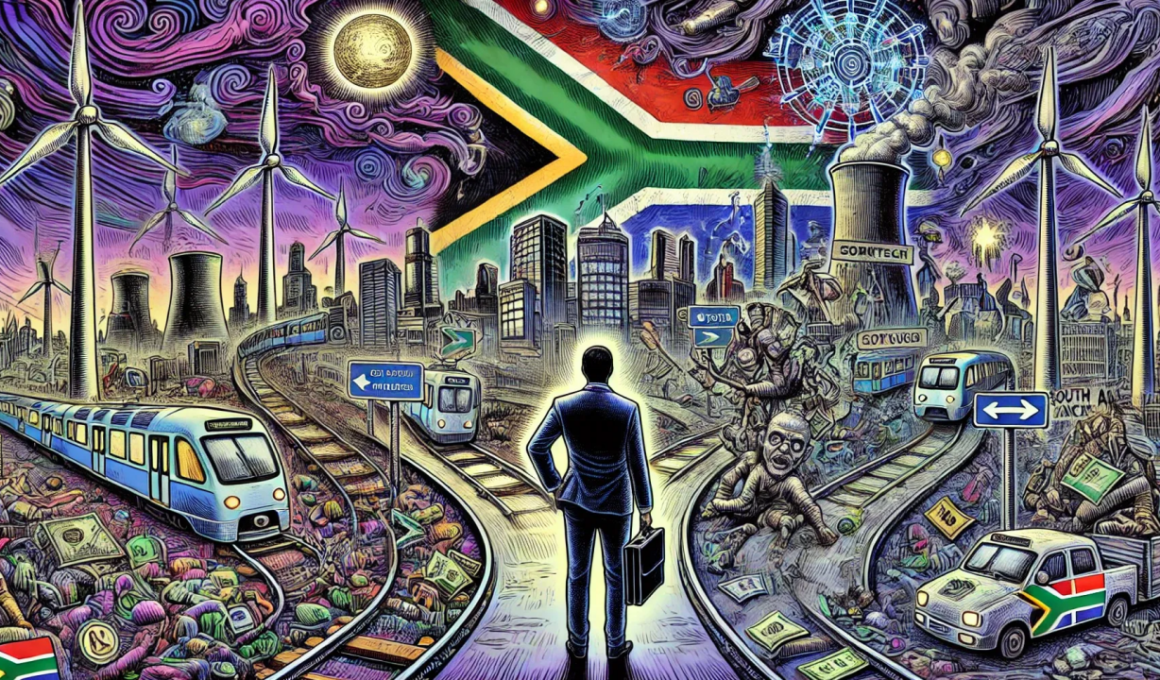
South Africa stands at a crossroads. The 2025 Budget Speech laid bare the nation’s economic vulnerabilities, exposing structural weaknesses that pose significant risks to investors. Yet, within these cracks lie opportunities—albeit selective and sector-specific. For investors navigating South Africa’s complex economic terrain, understanding both the perils and potential is critical.
The Risk Landscape: A Struggling Economy with Deep-Rooted Challenges
Low Growth and Policy Paralysis
At a projected 1.8% GDP growth rate in the medium term (2025-2027), South Africa’s economy lacks the dynamism needed to attract large-scale investment. The absence of a clear industrial policy further erodes business confidence, leaving private sector investment stagnating below 15% of GDP—far from the 25% threshold required for sustainable expansion. Policy inconsistencies and slow reforms hinder sectors such as manufacturing and technology, where growth potential exists but remains unrealized.
Fiscal Constraints and the SOE Dilemma
The government’s debt burden is set to peak at 75.3% of GDP by 2025/26, with debt servicing costs devouring 22% of national revenue (R389.6 billion in 2025), exceeding budgets for social protection, healthcare, or security. Tax revenue shortfalls in 2023/24 amounted to R56.1 billion, driven by declining corporate profits and mining tax revenue. This fiscal straitjacket limits the government’s ability to drive economic stimulus or infrastructural development.
State-owned enterprises (SOEs), particularly Eskom and Transnet, remain albatrosses around the economy’s neck. With Eskom receiving R150 billion in additional debt relief and Transnet reliant on R47 billion in guarantees, these entities continue to drain public finances with no concrete turnaround strategies in place. The crisis extends to municipalities, where 30% are in financial distress, further exacerbating service delivery failures and deterring business investment.
Energy and Logistics Bottlenecks Stifle Competitiveness
Power and transport inefficiencies form a double bind, crippling South Africa’s industrial and export sectors. Transnet’s logistical inefficiencies cost the economy nearly R1 billion per day, while Eskom’s ongoing struggles resulted in R330 billion in GDP losses due to load shedding in 2024 alone. Renewable energy projects offer a glimmer of hope, with the government increasing the limit for renewable energy projects under the carbon offsets regime from 15MW to 30MW. However, bureaucratic red tape continues to slow integration into the grid. Freight rail liberalization is expected by May 2024, and Pier 2 of Durban Container Terminal has been handed to a private operator to improve efficiency, potentially alleviating logistics constraints. Until these bottlenecks are resolved, key sectors like mining, manufacturing, and exports will remain high-risk investment areas.
Tax and Wage Pressures Weigh on Growth
The recent VAT increase to 16% disproportionately affects consumers, squeezing disposable incomes and dampening demand for retail and fast-moving consumer goods (FMCG). Excise duties on alcohol and tobacco have risen by 6.7-7.2%, further pressuring consumer spending. Meanwhile, the government’s rigid wage bill—where public sector salaries consume 35% of tax revenue—leaves little fiscal flexibility. These structural inefficiencies create a challenging landscape for businesses dependent on domestic consumption.
A Selective Investment Play: Opportunities Amidst the Chaos
Despite these headwinds, targeted investment opportunities exist, particularly for those with a high-risk appetite and a strategic focus on sectors benefiting from emerging reforms and structural inefficiencies.
Infrastructure & Energy: Private Sector Openings
While SOEs remain high-risk, government-led public-private partnerships (PPPs) in infrastructure and energy present new avenues for investment. The government is introducing regulatory reforms to streamline PPP approvals, aiming to unlock private investment in infrastructure. The ongoing transition away from Eskom’s monopoly provides opportunities in renewable energy, independent power production (IPPs), and grid decentralization. Additionally, reforms in port and rail logistics, if implemented effectively, could unlock high-return investments in freight and transportation.
Tech-Driven Consumer Growth
The broader consumer market remains sluggish, but niche sectors like fintech, agribusiness, and healthcare technology are poised for expansion. South Africa retains Africa’s most sophisticated financial sector, making fintech, insurance, and banking attractive for investors with an eye on regulatory advancements. E-commerce and pharmaceutical industries also present growth potential, particularly as digital adoption accelerates.
Selective Manufacturing and Export Advantage
Despite an overall decline in manufacturing, specific subsectors—such as automotive production and high-value agribusiness—stand to benefit from regional trade agreements like the African Continental Free Trade Area (AfCFTA). A 150% investment allowance will be introduced in March 2026 for new electric and hydrogen-powered vehicle production, creating opportunities in the automotive sector. Mining, particularly in platinum, battery metals, and gold, remains an attractive sector but comes with significant energy-related operational risks. Export-driven industries with government incentives could provide a hedge against domestic economic stagnation.
The Investment Outlook: Caution with Strategic Entry
In the short term (1-3 years), South Africa’s investment landscape remains precarious due to fiscal stress, low economic growth, and uncertainty surrounding key reforms. Investors should tread carefully, prioritizing sectors with government-backed incentives or emerging private-sector participation.
Over the medium term (3-5 years), opportunities could materialize if policy execution improves—especially in energy reforms, logistics liberalization, and tax incentives for businesses. Investors willing to endure volatility may find promising long-term returns in high-growth niches.
Beyond five years, South Africa’s investment case hinges on its ability to implement structural changes. If SOE reforms, labor market flexibility, and industrial policies are successfully overhauled, the country could transition into a more stable and lucrative investment destination. However, execution risks remain high, and past governance failures suggest a cautious approach.
Bottom Line: High Risk, High Reward—But Not for Everyone
South Africa is not a broad-based investment haven at present. However, for investors willing to navigate its uncertainties, there are select opportunities in energy, infrastructure, niche consumer markets, and export-oriented manufacturing. The key is to align investments with sectors benefiting from policy tailwinds while hedging against fiscal instability, SOE dysfunction, and a fragile consumer base.
In an economy marked by contradictions, strategic positioning will separate winners from those caught in the turbulence of South Africa’s unresolved economic dilemmas.
Disclaimer
The information provided in my articles is for informational purposes only and should not be construed as financial advice. While I strive to provide accurate and up-to-date information, I do not guarantee the correctness, completeness, or reliability of any facts, figures, or statements presented. Any actions taken based on the content of my articles are solely at the reader’s own risk. It is strongly recommended that you consult with a professional financial advisor before making any financial decisions. I disclaim any liability for any loss or damage arising from reliance on the information provided.