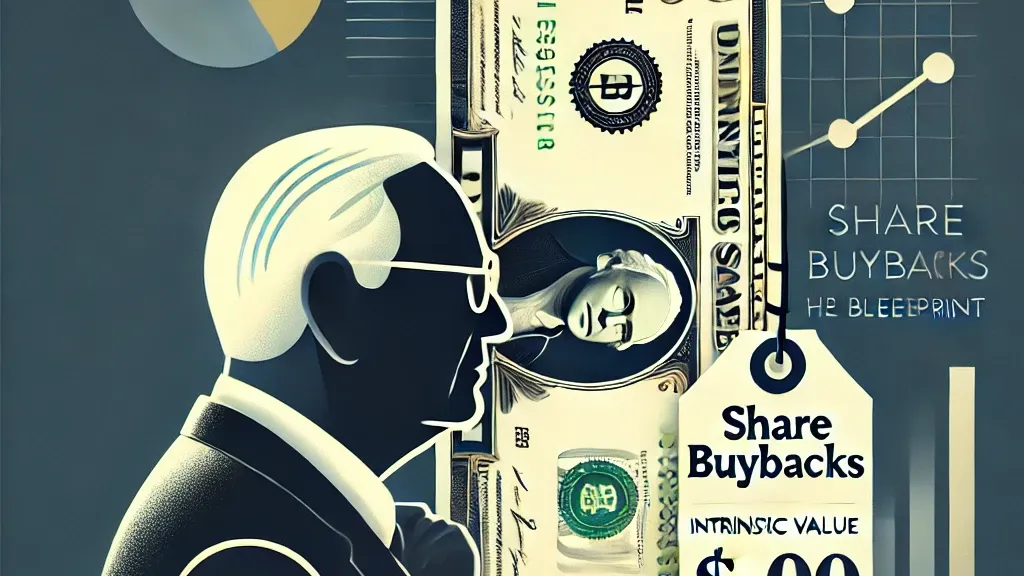
A share buyback isn’t just “financial engineering.” When done right, it’s one of the sharpest tools in the capital allocation toolbox — and a core pillar of Warren Buffett’s wealth-building playbook.
Here’s what most investors miss about buybacks — and how the best CEOs use them to quietly compound shareholder returns.
When a company repurchases its own shares, it reduces the number of shares outstanding — increasing each remaining shareholder’s slice of the pie.
But here’s the catch:
- Buybacks only create value if the stock is trading below intrinsic worth.
- And only if the company truly has no higher-return use for that cash.
Buffett’s test is timeless:
“Buying dollar bills for 80 cents is good business.” — 2011 Letter to Shareholders
Buffett’s 2-Part Test for Smart Buybacks
- Surplus capital — After fully funding operations, growth, and contingencies.
- Clear undervaluation — The stock must trade below conservative intrinsic value.
“We won’t buy a dollar for 90 cents unless we’re sure it’s worth a dollar.” — 2020 Letter
No value? No buyback. Otherwise, it’s just EPS cosmetics.
Buybacks vs. Dividends: Buffett’s View
Why Buffett often favors buybacks over dividends:

Buffett’s capital return order of operations:
“Reinvest first. Acquire wisely. Buy back undervalued stock. Pay dividends last.”
Buffett-Approved Buyback Case Studies
- Apple (2016–2024): Apple’s buybacks increased Berkshire’s stake without adding shares.
“It’s like receiving a dividend — only more tax-efficient.” — 2021 Letter
- Berkshire Hathaway (2020–2021): Buffett repurchased $51B in stock when he believed it traded below intrinsic value.
- Washington Post (1980s): Strategic buybacks quietly grew Berkshire’s stake with no new purchases.
When Buybacks Backfire
- Buying overpriced stock → You destroy value.
- Using debt to fund buybacks → You leverage risk.
- Doing it to boost EPS optics → You’re managing perception, not capital.
“Many CEOs buy back shares to look smart, not to create value.” — Buffett
Buffett’s 2024 Litmus Test for CEOs
“If you wouldn’t buy the entire company at this price, why are you buying back a slice?”
In other words: Every repurchase should leave remaining shareholders better off per dollar spent.
Final Word: Buybacks Aren’t Evil — They’re Powerful
Used with discipline, buybacks are a rational, Buffett-endorsed way to return capital and boost per-share value. But like fire, they require judgment.
The Buffett Checklist:
- Excess cash
- Undervalued stock
- Clear long-term benefit to continuing shareholders
Anything less? You’re not creating value — you’re just playing the game.
Sources:
Berkshire Hathaway Inc. (1999) Letter to Shareholders. Omaha, NE: Berkshire Hathaway Inc. Available at: https://www.berkshirehathaway.com/letters/1999html.html
Berkshire Hathaway Inc. (2011) Letter to Shareholders. Omaha, NE: Berkshire Hathaway Inc. Available at: https://www.berkshirehathaway.com/letters/2011ltr.pdf
Berkshire Hathaway Inc. (2020) Letter to Shareholders. Omaha, NE: Berkshire Hathaway Inc. Available at: https://www.berkshirehathaway.com/letters/2020ltr.pdf
Berkshire Hathaway Inc. (2021) Letter to Shareholders. Omaha, NE: Berkshire Hathaway Inc. Available at: https://www.berkshirehathaway.com/letters/2021ltr.pdf
Berkshire Hathaway Inc. (2022) Letter to Shareholders. Omaha, NE: Berkshire Hathaway Inc. Available at: https://www.berkshirehathaway.com/letters/2022ltr.pdf
Berkshire Hathaway Inc. (2024) Combined Shareholder Letters 1977–2024 [PDF]. Compiled document, provided by user.