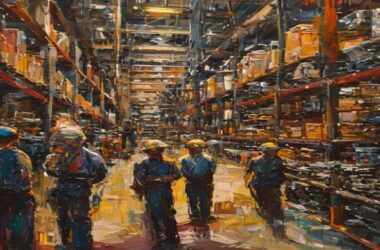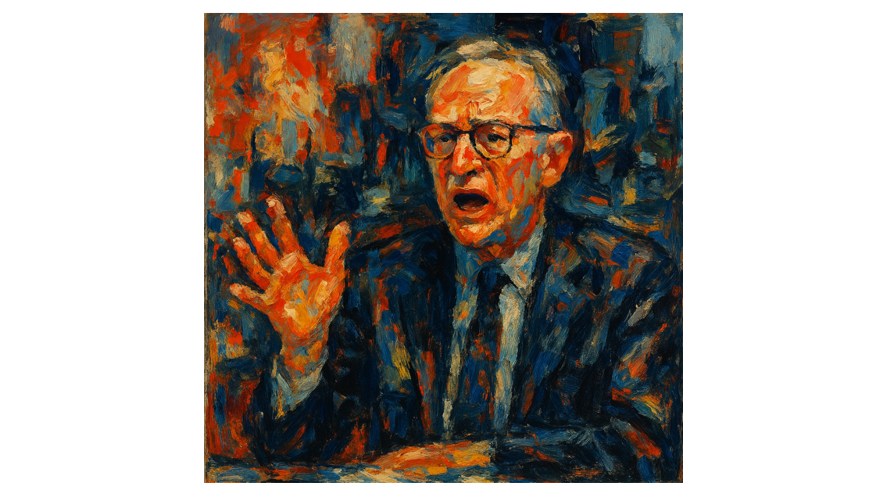
“This is the biggest change in the environment that I’ve seen probably in my career.” That’s the stark warning from Howard Marks, co-chair of Oaktree Capital, during his April 2025 Bloomberg interview on the return of protectionism and its far-reaching macroeconomic and market implications (Marks, 2025).
In a world defined for decades by global integration, the retreat into tariffs marks not just a pivot—but a paradigm shift. The postwar playbook of liberalized trade, comparative advantage, and disinflation is being rewritten. Investors and policymakers alike must adapt to a new reality: one where economic walls go up, costs rise, and inflation returns as a structural feature—not a cyclical glitch.
I. The End of the Globalization Dividend
For nearly 80 years, globalization wasn’t just an economic tailwind—it was the defining force behind rising living standards, low consumer prices, and capital market efficiency. As Marks explains:
“Worldwide welfare is maximized when every country does the things it does best and cheapest” (Marks, 2025).
That logic underpinned everything from TV prices to S&P 500 profit margins. Between 1995 and 2020, the real price of durable goods in the U.S. fell by nearly 5% (Marks, 2025). The efficiency gains were real—and they kept inflation in check.
But that system is breaking down. The resurgence of tariffs—on a scale not seen in a century—is reversing decades of economic integration. As Marks notes:
“We’ve gone from free trade and globalization to a system which implies significant restrictions on trade… and a step toward isolation” (Marks, 2025).
If Italians must make their own watches and the Swiss their own pasta, the costs are more than cultural—they’re economic.
II. Tariffs Are the New Tax—and the Consumer Pays
Protectionism may sound patriotic, but it’s paid for at the checkout line. Tariffs are taxes—disguised as policy. Marks doesn’t mince words:
“There were financial benefits from globalization, including keeping a lid on inflation… Tariffs are an increased cost. Somebody has to pay them” (Marks, 2025).
Warren Buffett captured this cost dynamic with brutal clarity:
“Inflation acts as a gigantic corporate tapeworm. It simply consumes earnings and leaves behind a slimmer enterprise” (Buffett, 1981).
The tapeworm is back. Supply chains rerouted by policy, not price, lead to higher domestic production costs. These costs ripple down to both consumers and shareholders, impacting earnings and equity valuations.
III. From Disinflation to De-Globalization
Marks cites a powerful stat: for 25 years, U.S. durable goods prices declined by 4.8% in real terms—a disinflationary tailwind driven by global supply chain optimization (Marks, 2025). That engine has now stalled.
Tariffs, reshoring, and geopolitical friction are replacing that dynamic with a cost-push inflation regime—the kind of inflation central banks can’t easily tame.
This isn’t about a soft landing—it’s about system redesign: lower productivity, persistent inflation, and constrained monetary tools.
IV. Implications for Investors: Watch the Credit, Not the Crowd
“Equities have averaged 10% annually—but not when the P/E was 19.” —Howard Marks (2025)
In a world of slowing growth and rising costs, equities priced for perfection may underdeliver. Marks urges caution: the sky-high valuations of the past decade were built on the foundations of stable globalization and low inflation—neither of which are assured going forward.
Buffett’s timeless wisdom?
“It’s better to be in businesses where tailwinds prevail rather than headwinds” (Buffett, 1977).
In today’s headwind-heavy market, Marks highlights relative safety in credit markets. As of April 2025, high-yield bonds offered near 8% returns—better compensation for macro risk (Marks, 2025).
“What you see is what you get,” Marks says of credit investing in this new regime.
V. What Value Investors Should Be Asking
It’s no longer enough to screen for low P/E ratios or chase dividend yields. As Paul Kazarian put it:
“Enduring investment success often stems from identifying systemic misconceptions” (Kazarian, 2020).
Protectionism is one such misconception—assumed to be benign, but economically corrosive.
Buffett’s classic warning still holds:
“Only when the tide goes out do you discover who’s been swimming naked” (Buffett, 2011).
The tide today? The unwinding of global trade. Value investors must ask:
- Can this business thrive with localized supply chains?
- Does it have pricing power in an inflationary environment?
- Can it protect margins when input costs spike unpredictably?
VI. Conclusion: Building Arks in an Age of Uncertainty
As Marks cautions:
“The probability that we know what the future is going to look like is lower than ever” (Marks, 2025).
Prediction is no longer enough. Strategy is survival.
Buffett would agree:
“Predicting rain doesn’t count. Building arks does” (Buffett, quoted in Schroeder, 2008, p. 823).
The arc of globalization is bending inward. Tariffs are the spark, inflation the flame. Investors, executives, and policymakers must now navigate not just a market correction—but a new macro climate.
What’s your take? Are tariffs a necessary correction—or a structural headwind for equity markets? Drop your best alpha thesis below.
References
Howard Marks
- Marks, H., 2025. Interview on Bloomberg TV: Oaktree’s Howard Marks on Credit Yields, Trump’s Tariffs. [transcript] 7 April 2025. [Source: YouTube, Bloomberg TV]
Warren Buffett
- Buffett, W.E., 1977. Berkshire Hathaway Inc. Shareholder Letters.
- Buffett, W.E., 1981. Shareholder Letter: Berkshire Hathaway Inc.
- Buffett, W.E., 2011. Trip to Omaha with Warren Buffett. Graham & Doddsville, Winter Issue XI.
Academic & Supplementary
Schroeder, A., 2008. The Snowball: Warren Buffett and the Business of Life. London: Bloomsbury.
Kazarian, P.B., 2020. Paul B. Kazarian: Japonica’s Philosophy on Value Creation. Graham & Doddsville, Winter Issue XXXVIII.
Lowenstein, R., 1995. Buffett: The Making of an American Capitalist. New York: Random House.